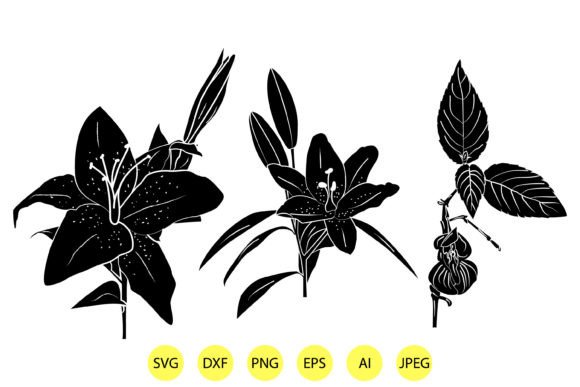
Silhouette of Lily Flowers Illustrations
There is a distinct power in the absence of color. When you strip away the delicate gradients, the soft pinks, and the vibrant yellows of a garden scene, what remains is often more striking than the original. This is the essence of Silhouette of Lily Flowers Illustrations. By isolating the flower against a stark white background, you transform a botanical subject into a graphic symbol that speaks volumes about elegance, structure, and form.
For creators looking to elevate their visual language without cluttering the design space, these vector silhouettes offer a versatile foundation. Whether you are designing a wedding invitation, creating a logo for a boutique skincare brand, or illustrating a chapter header for a literary blog, the clean lines of a blooming lily provide an immediate sense of sophistication. The silhouette does not just represent a flower; it represents the concept of growth, purity, and natural beauty in its most refined state.
The Artistic Value of Minimalist Florals
In a digital landscape saturated with high-resolution photography and complex textures, minimalism stands out. A black decorative blooming lily silhouette cuts through the noise. It relies on negative space and positive shape to create interest. This approach is particularly effective when you need a focal point that doesn't overwhelm the viewer.
The specific characteristics of the lily make it an ideal candidate for this treatment. The trumpet shape of the bloom, the sweeping curves of the petals, and the distinctive stamens create a recognizable outline that is both organic and geometric. When converted into a vector format, these details become scalable assets. You can shrink them down to fit a favicon or expand them to cover a billboard, and the crisp edges will remain intact. This scalability is crucial for professionals who need consistency across various media formats.
Why Vector Silhouettes Matter
Choosing a vector-based set over raster images is a strategic decision for any designer. Raster images, like standard JPEGs, lose quality when resized. Vector graphics, however, are defined by mathematical paths. This means your Silhouette of Lily Flowers Illustrations will look perfect at any size. The inclusion of multiple file formats ensures compatibility with every stage of your workflow.
- Adobe Illustrator (AI) and EPS files allow for deep editing. You can manipulate anchor points, change stroke weights, or break apart the individual petals to create new patterns.
- SVG is the gold standard for web design. These files load quickly and remain sharp on retina displays, making them perfect for responsive websites.
- PNG and JPEG provide ready-to-use options for social media posts, email newsletters, and print proofs where layer editing isn't required.
- DXF opens doors to physical fabrication. If you use a laser cutter or CNC machine to create signage or wall art, this format allows your digital design to translate perfectly into physical materials.
Creative Applications Across Industries
The utility of these illustrations extends far beyond simple decoration. Different industries can adapt the same asset to meet specific goals while maintaining a cohesive aesthetic. For marketers, a lily silhouette serves as a powerful icon for branding. It conveys trust and freshness, which are essential attributes for health, wellness, and lifestyle products.
Consider a small business owner launching a line of organic soaps. They might place the flower motif sketch on the packaging label. The high contrast of the black silhouette against a pastel or white background creates a premium look that suggests quality ingredients. Similarly, educators can use these icons to illustrate biology textbooks or nature guides. The clarity of the silhouette helps students identify the structural components of the flower without the distraction of photographic detail.
Blogger and content creators often struggle with finding unique imagery that aligns with their brand identity. Stock photos can feel generic. Using a custom set of vector black silhouettes of flowers allows you to maintain a consistent visual voice. You can tint the silhouette to match your brand colors or keep it monochromatic for a timeless look. This flexibility turns a single purchase into a long-term design resource.
Project Ideas for Designers and Hobbyists
If you are feeling stuck on your next creative project, here are several practical ways to integrate these illustrations:
- Tattoo Designs: The bold lines of a lily silhouette are classic tattoo motifs. Artists can easily modify the thickness of the lines to suit different skin tones and styles, from fine line work to traditional bold shading.
- Wedding Stationery: Invitations, programs, and table numbers benefit from the romantic yet formal vibe of a lily. The isolated nature of the image allows for easy integration with typography and other floral elements.
- Textile Patterns: Repeat the silhouette to create a seamless pattern for fabric printing, wallpaper, or wrapping paper. The simplicity of the shape ensures the pattern remains readable even when scaled up.
- App Icons: For fitness or meditation apps, a blooming lily can symbolize mindfulness and growth. The clean vector file ensures the icon looks crisp on all device screens.
Maintaining Consistency and Originality
While using pre-made assets is efficient, adding a personal touch is what separates amateur designs from professional ones. When working with Silhouette of Lily Flowers Illustrations, avoid simply dropping the image onto a canvas and expecting it to stand alone. Instead, treat the silhouette as a building block.
Experiment with layering. Place the lily behind a semi-transparent text box to create depth. Combine it with other botanical silhouettes to build a lush garden scene. Use the DXF file to cut shapes out of wood or acrylic, then paint them in metallic finishes for a modern decor piece. The key is to understand the geometry of the flower. Once you know how the petals overlap and how the stem curves, you can deconstruct the image and rebuild it in a way that feels entirely new.
Consistency is also about technical execution. Ensure that your lines are smooth and your corners are sharp. If you are using the AI file, check your layers to ensure they are organized. Name your layers clearly (e.g., "Petal_Left," "Stamen," "Background") so that future edits are straightforward. This organizational discipline pays off when you need to tweak a design last minute or hand off the file to a colleague.
Adapting for Modern Platforms
In today's multi-platform world, your design must be fluid. A logo that works on a business card might fail on a mobile app if it lacks the right resolution or file type. The comprehensive package provided—ranging from SVG to EPS—means you are prepared for every scenario. You can start with the high-resolution PDF for print proofs, move to the AI file for final adjustments, and export the PNG for social media sharing.
When adapting these silhouettes for digital platforms, remember that user experience is paramount. On a website, the SVG version ensures fast loading times and sharp rendering. On Instagram, the high-contrast JPEG version will perform well against busy backgrounds. By having access to the source files, you retain control over the final output, ensuring that your flower icon always looks its best regardless of the medium.
Ultimately, the value of Silhouette of Lily Flowers Illustrations lies in their ability to bridge the gap between artistic expression and functional design. They offer a timeless aesthetic that can be molded to fit contemporary trends or classic traditions. For the creative professional, they are not just images; they are tools for communication, capable of conveying messages of elegance and nature with absolute clarity.